
The Anatomy of High-Converting Ecommerce Emails (Without Discounts)
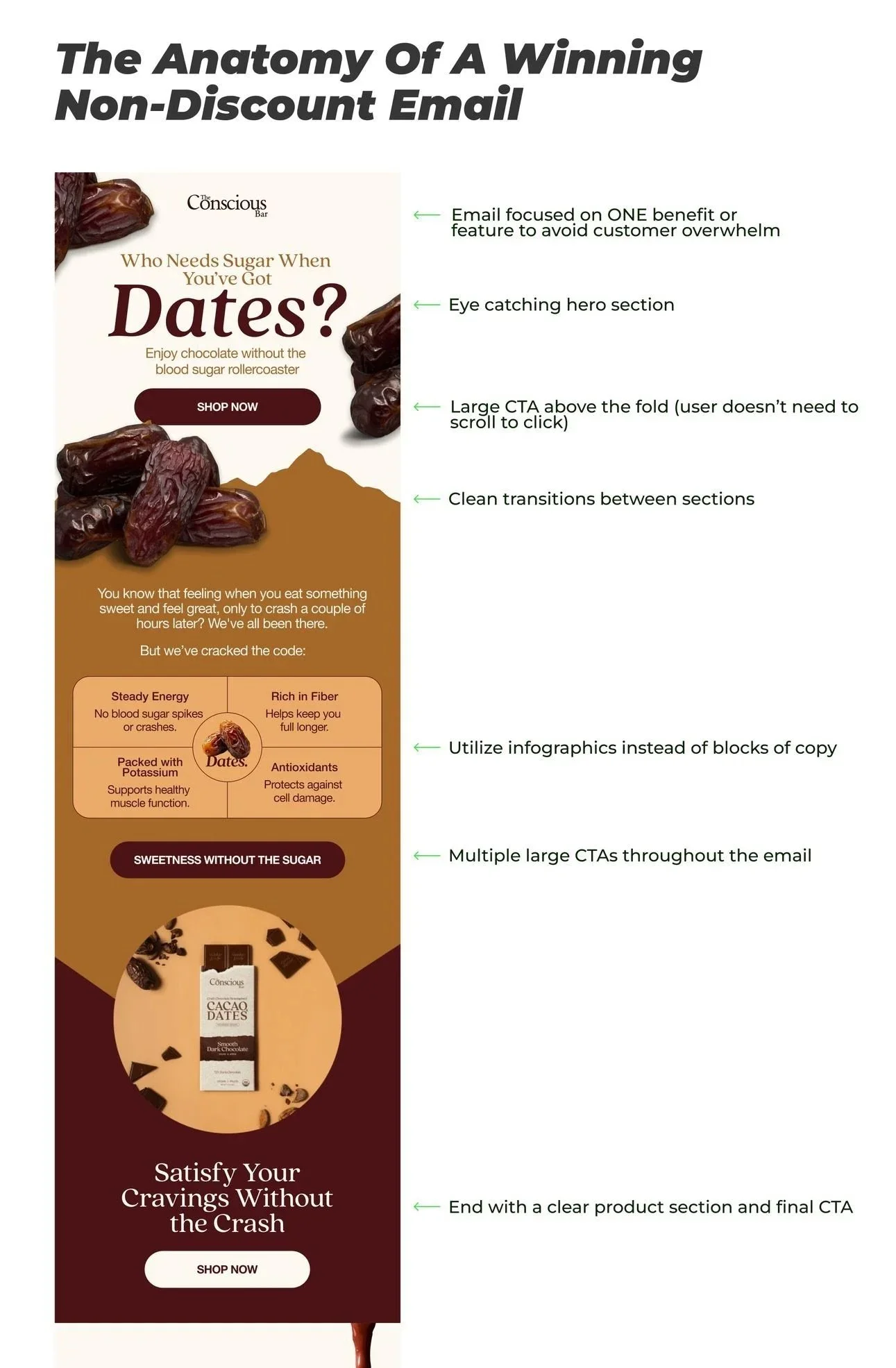
Most marketing emails fail for one simple reason:
They try to do too much.
When an email attempts to highlight every product feature, promotion, and brand message at once, the reader gets overwhelmed. And when everything is important, nothing stands out.
The highest-performing ecommerce emails follow a different philosophy: one email, one message, one action.
At Sprout Media, we analyze email campaigns across ecommerce industries like jewelry, fashion, florists, and luxury retail. The most profitable brands consistently follow the same structure when designing emails that convert without relying on discounts.
Below is the exact anatomy of the emails generating millions in revenue for top ecommerce brands.
1. One Email Should Focus on One Clear Benefit
Customers scan emails quickly. They rarely read them word for word.
That means your email must communicate one single benefit immediately.
Trying to explain multiple features in one email weakens the message.
Instead, each email should revolve around one strong idea.
Examples of focused benefit messaging:
• “The cleanest protein on the market — with zero bloating.”
• “Designed to reduce breakouts in 14 days.”
• “A 5-second setup that saves 10 minutes every morning.”
Pick one benefit and build the entire email around it.
When the message is simple, conversion rates increase.
2. The Hero Section Must Stop the Scroll
The hero section is the most important part of the email.
Within seconds, the reader should understand exactly what the product does and why it matters to them.
Strong hero sections combine:
• a bold headline
• a compelling image
• a clear value proposition
Avoid vague headlines like:
“New Collection”
“Our Latest Drop”
Instead, write benefit-driven headlines such as:
“Hydrated Skin All Day — Without the Grease”
“Tired of Back Pain? This Might Be Why.”
If the hero section fails to grab attention, the reader will never scroll further.
3. Place Your First CTA Above the Fold
One of the biggest mistakes ecommerce brands make is hiding the call-to-action too far down the email.
If a reader never scrolls, they should still have a chance to click.
That means the first CTA must appear above the fold — within the first screen.
Best practices include:
• large CTA buttons
• clear text such as “Shop Now” or “See How It Works”
• strong visual contrast
This creates an immediate action path for motivated buyers.
4. Create Clean Transitions Between Sections
After capturing attention, the goal becomes maintaining momentum.
Emails should be broken into simple sections that guide the reader naturally through the story.
Examples of effective transition headers include:
• “Here’s how it works”
• “Why customers are switching”
• “You might be skeptical — that’s fair”
These small transitions keep the reader engaged while reinforcing your core benefit.
5. Use Infographics Instead of Long Paragraphs
Most ecommerce emails contain far too much text.
But customers make decisions visually.
Instead of writing long explanations about your product, convert complex information into infographics or visual diagrams.
Visual content allows readers to:
• absorb information faster
• understand product benefits quickly
• stay engaged on mobile devices
Infographics often outperform long copy because they simplify the buying decision.
6. Repeat CTAs Without Being Pushy
One CTA is rarely enough.
People click when they feel ready — not when the email designer decides.
High-performing ecommerce emails place multiple CTAs throughout the email.
Typical structure:
• one CTA near the top
• one CTA after a key benefit or testimonial
• one CTA near the product section
Repetition reinforces the message and increases click-through rates.
7. End With a Clean Product Section
The final section of the email should remove any remaining friction.
This section typically includes:
• product image
• product name
• optional price
• final CTA button
Keep this area extremely simple.
No clutter.
No additional messaging.
Just the product and the action button.
This reinforces the purchase decision and makes the next step obvious.
Why High-Performing Ecommerce Emails Avoid Discounting
Many ecommerce brands rely on discounts to drive conversions.
But the most profitable brands focus on value-driven messaging instead.
Non-discount emails work because they:
• strengthen brand perception
• protect profit margins
• build long-term customer trust
Instead of competing on price, they compete on clarity and product value.
The Role of Email Marketing in Ecommerce Growth
Email marketing remains one of the most profitable channels for ecommerce brands.
Well-designed email campaigns help brands:
• convert more website visitors
• recover abandoned carts
• increase repeat purchases
• improve customer lifetime value
For many ecommerce businesses, 20–40% of total revenue comes from email marketing alone.
How Sprout Media Builds High-Converting Email Systems
At Sprout Media, we help ecommerce brands implement advanced email marketing systems designed to drive revenue and retention.
Our approach focuses on:
• lifecycle email automation
• Klaviyo flow optimization
• ecommerce retention marketing
• conversion-driven email design
We work with ecommerce brands in industries including jewelry, fashion, luxury retail, and florists to build email systems that generate revenue automatically.
Final Takeaway
The best ecommerce emails are not complicated.
They are focused.
One benefit.
One story.
One action.
When your emails follow this structure, they become far more effective at converting customers without relying on constant discounts.
For ecommerce brands looking to scale sustainably, email marketing remains one of the most powerful growth engines available.
If you'd like help building high-converting email systems for your ecommerce brand, visit:
https://www.thesproutmedia.com
and learn how Sprout Media helps ecommerce brands grow through advanced email marketing and retention strategies.