
Law Firm Keywords:
A Quick Guide for Lawyers
How to find the search terms your potential clients use, outrank competitors, and build a keyword strategy that consistently attracts new cases.
A recent study revealed that up to 66% of call conversions for law firms come from organic search. If you want potential clients to find you online, you need to use the right law firm keywords in your content to boost search visibility.
In this guide, we'll cover how to do keyword research, how to use legal keywords in your website content, and the tools you can use for your law firm's SEO campaign.
What to Know About SEO Keywords
Keywords are the words and phrases people use when searching online for solutions. As an attorney, you want your website to rank for the most relevant SEO keywords so that when prospects search for those terms, your firm appears at the top of search engine results pages (SERPs).
There are two main types of keywords every law firm should understand:
Broad, highly competitive phrases with high search volume but low conversion rates. Difficult to rank for and attract people at many different stages of intent.
- personal injury lawyer
- divorce attorney
- criminal defense law
More specific phrases that may include local SEO terms. Lower competition, higher purchase intent, and roughly 83% of all organic traffic.
- divorce attorney near me
- what to do after a car accident
- child adoption process in California
Since roughly 83% of organic website traffic comes from long-tail keywords, you can significantly enhance your search engine ranking by incorporating these high-volume, lower-competition phrases. Plus, long-tail searches tend to have much higher conversion rates because they reflect specific intent.
Tips for Law Firm Keyword Research
Keyword research is the process of finding the keywords or phrases that your target audience uses when searching online. Here's a step-by-step guide to building a solid keyword strategy for your law firm:
1 Identify your seed keywords
Seed keywords are the root phrases that define your practice areas. For example, entering the seed keyword "car accident" into a keyword tool like Moz returns related terms with volume and difficulty data:
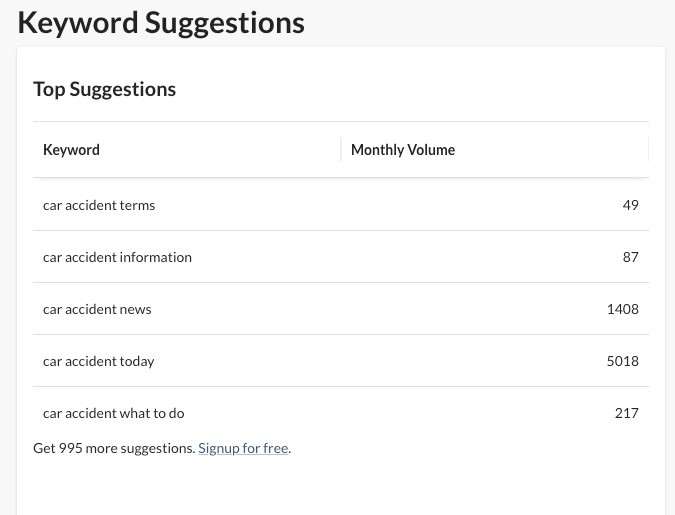
Seed keywords are the foundation of a strong SEO strategy. By starting with these core terms, you can efficiently expand into relevant topics, uncover content opportunities, and build a scalable keyword strategy that keeps your site aligned with user intent.
2 Determine keywords your competitors rank for
You don't need to rank for everything — you just need to be more visible than your competitors in the searches that matter most. Figuring out what keywords they rank for reveals where you can beat them and where you can go around them entirely.
Use tools like Ahrefs, Moz, Semrush, or Google's Keyword Planner to find competitor keyword gaps and the highest-value opportunities in your market.
3 Run matching term reports
The Matching Terms report in Ahrefs is one of the most powerful tools for expanding your keyword list. Think of it as "People also search for" — but backed by real search volume and difficulty data:
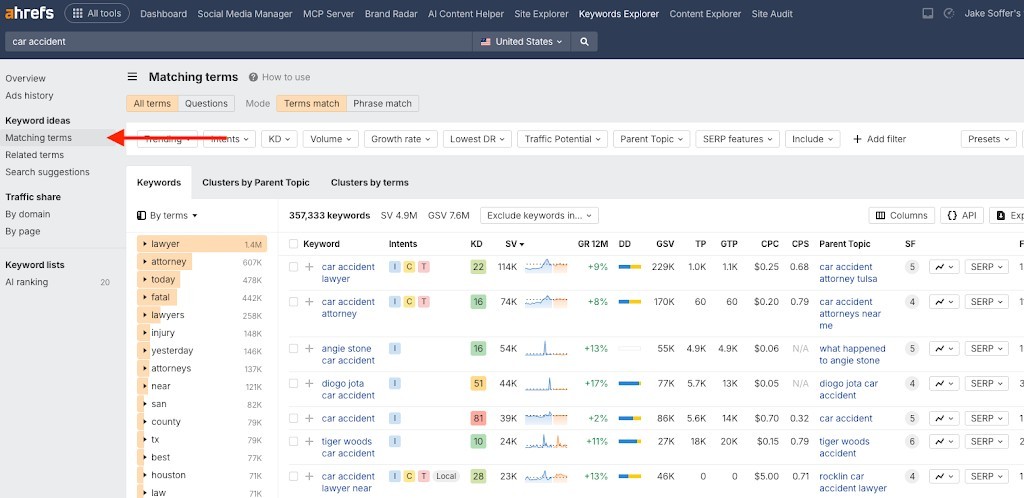
By analyzing these related terms, you can expand your content strategy, target a wider range of search intents, and strengthen your overall keyword coverage for better SEO visibility.
4 Explore what people actually search
Often, attorneys start content creation with questions they think people need to know. That's a good instinct — but it doesn't always match what people are actually typing into Google. Use Ahrefs to pinpoint the exact questions searchers ask about your practice areas:

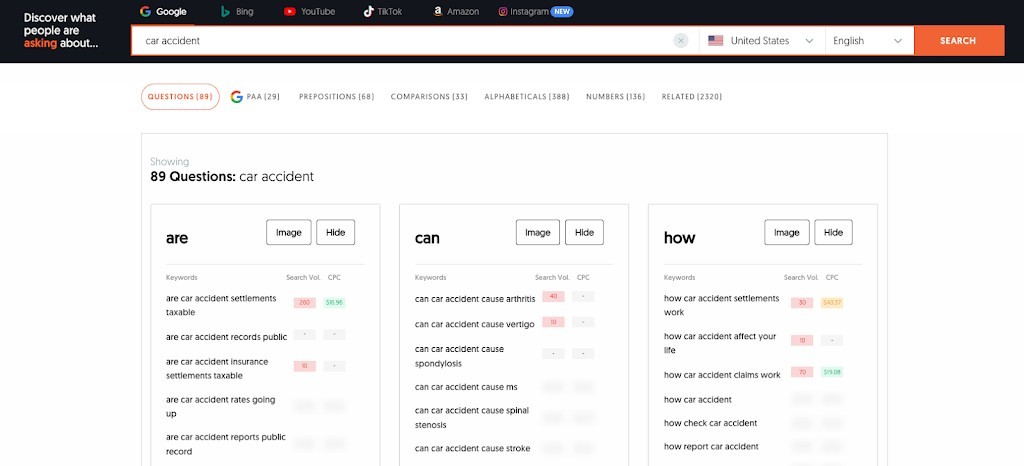
Go beyond SEO tools too. Websites like Justia, Lawyer.com, and Answer the Public can help you visualize the questions your target audience is actually asking. These Q&A platforms are goldmines for long-tail keyword ideas with high conversion intent.
Answer the Public lets you enter any keyword or phrase to instantly see every "how," "what," "when," "where," and "why" question people ask about it online — perfect for building a blog content calendar around real client questions.
5 Build your keyword strategy
Once you've completed your keyword research, decide which keywords to target first. The key is finding the right balance between keyword difficulty and search volume — terms enough people are searching for that your firm can realistically rank for.
Focus on keywords that align with your practice areas, but don't overlook long-tail keywords. More specific phrases tend to attract visitors with stronger intent to take action. It's also important to distinguish between:
- High-intent keywords ("hire a personal injury lawyer") — signal someone is ready to contact an attorney now.
- Low-intent keywords ("what does a personal injury lawyer do") — indicate early-stage research. Still valuable for building trust and visibility early in the client journey.
A strong keyword strategy uses both types. Track your priority keywords in a spreadsheet to map each piece of content to a specific target term.
6 Structure your content with keywords
This is where you write the actual content — blog posts, practice area pages, location pages, and social media posts — that speaks directly to these keywords. Keep it simple and provide clear answers to the questions your keywords represent.
Good keyword-based formatting helps in two ways:
- It makes your content more accessible to read. Use short paragraphs and subheadings with active verbs that are easy to scan and understand.
- Proper formatting signals content quality to search engines — both structure and substance matter for rankings.
Strategically place your primary keyword in page titles, H1 and H2 headings, meta descriptions, and image alt text — without overstuffing. The goal is to make your content genuinely helpful for users and clear for search engines, so your law firm stands out in competitive results.
7 Monitor your results
Once your keyword strategy is in motion, consistent monitoring is essential to measure performance and refine your approach. Pay close attention to:
- Organic traffic — Are more people finding your site through search?
- Click-through rates (CTR) — Are people clicking your results when they appear?
- Impressions — How often are your pages appearing in search results?
- Conversions — Are those visitors turning into consultations and signed cases?
Regular reporting lets you spot trends and make data-driven decisions. If certain keywords are gaining traction, build more content around them. If others are underperforming, update the related pages or shift focus to new opportunities. Consistent keyword tracking ensures your strategy remains proactive rather than reactive.
Keyword Research Tools for Attorney SEO
The right tools make keyword research productive and efficient. Here are the essential options for law firm SEO:
Integrates competitor analysis with deep keyword research. Shows monthly search volume, traffic potential, keyword difficulty, related keywords, and which law firm websites hold the top Google positions. The Matching Terms and Questions reports are particularly powerful for attorneys.
Enables long-tail keyword discovery, competitive monitoring, trends over time, and search volume analysis. Its content optimization feature recommends relevant legal keywords to improve on-page SEO and increase organic visibility for law firm websites.
Monitor changes in keyword popularity over time, compare multiple legal keywords, and identify emerging topics in your practice area. Particularly useful for spotting seasonal patterns in legal searches (e.g., DUI queries spike around holidays).
Provides keyword performance and difficulty data, site audits, link tracking, and domain research. Lawyers can use Moz Keyword Explorer to find high search-volume keywords and prioritize them within a broader SEO strategy.
Monitor how your law firm website currently performs in Google search. See impressions, click-through rates, average position, and the exact queries clients use to find you — all at no cost. Essential for identifying quick-win keywords you're already ranking for.
Get Started With Keyword Research Today
Keyword research is essential for lawyers looking to consistently attract new clients and scale their practice. Every day, 10,000+ people are searching online for legal help. If you use the right law firm keywords, you can gain more visibility and sign more clients.
At Sprout Media, we know that a busy law practice has little time for marketing and SEO copywriting. That's why we developed an AI platform that handles keyword research, content planning, and campaign execution for law firms — from local SEO to national PR. Find out how Sprout Media can help you grow your law practice.
→ Book a Free Demo with Sprout MediaFAQ
Everything attorneys need to know about SEO keywords — from keyword types and research tools to monthly costs and ROI.