Google Ads & Meta Ads for Florists
How We Generated 1,066% ROAS for Florists on Google Ads This Mother's Day | Sprout Media
Case Study — Mother's Day 2026

How We Generated a 1,066% ROAS for Florists on Google Ads This Mother's Day

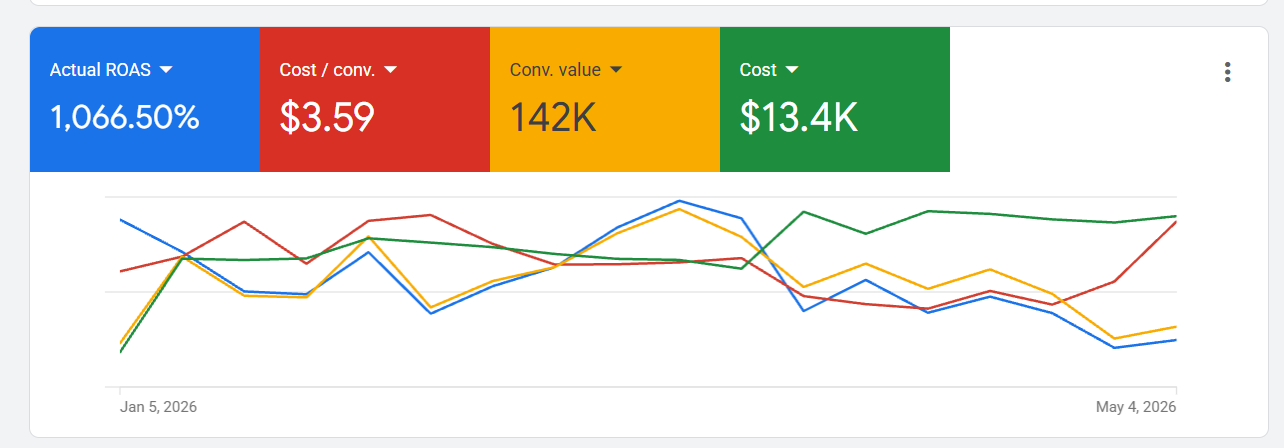
Real campaign data from January–May 2026: $142K in revenue on $13.4K in Google Ads spend. Here's the exact strategy we used — and why florists who run their own ads leave most of their revenue on the table.

Published May 12, 2026 · 8 min read · By Sprout Media Team
1,066%
ROAS — Top Campaign
$142K
Revenue Generated
$3.59
Cost Per Conversion
$13.4K
Total Ad Spend
268%
Blended Account ROAS

The Google Ads Opportunity Most Florists Are Missing

When someone types "same-day flower delivery Los Angeles" into Google, they have their wallet out. They are not browsing. They are not comparison shopping organic results. They want flowers, they want them today, and they are ready to buy from whoever shows up first with a compelling offer.

That's why Google Ads is, by far, the highest-ROI channel for florists. But only when campaigns are built correctly. Most florist Google Ads accounts we audit are running a single catch-all campaign, bidding on broad-match keywords, with no conversion tracking tied to revenue. The result? Wasted spend and the false belief that "Google Ads doesn't work for us."

It works. It just requires the right structure.

"For every $1 our top florist campaign spent on Google Ads this Mother's Day season, it returned $10.66 in revenue. That's the result of tight keyword structure, revenue-tracked bidding, and a campaign architecture built specifically for floral retail."

Our Mother's Day 2026 Google Ads Results

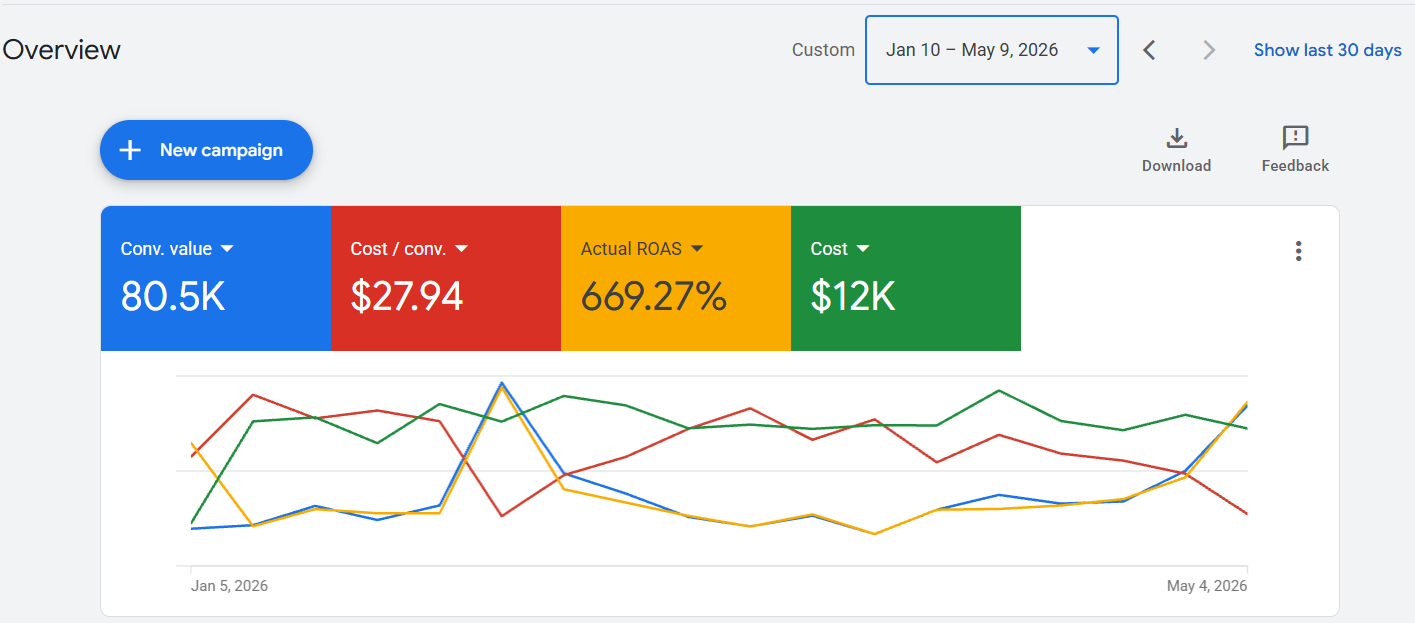
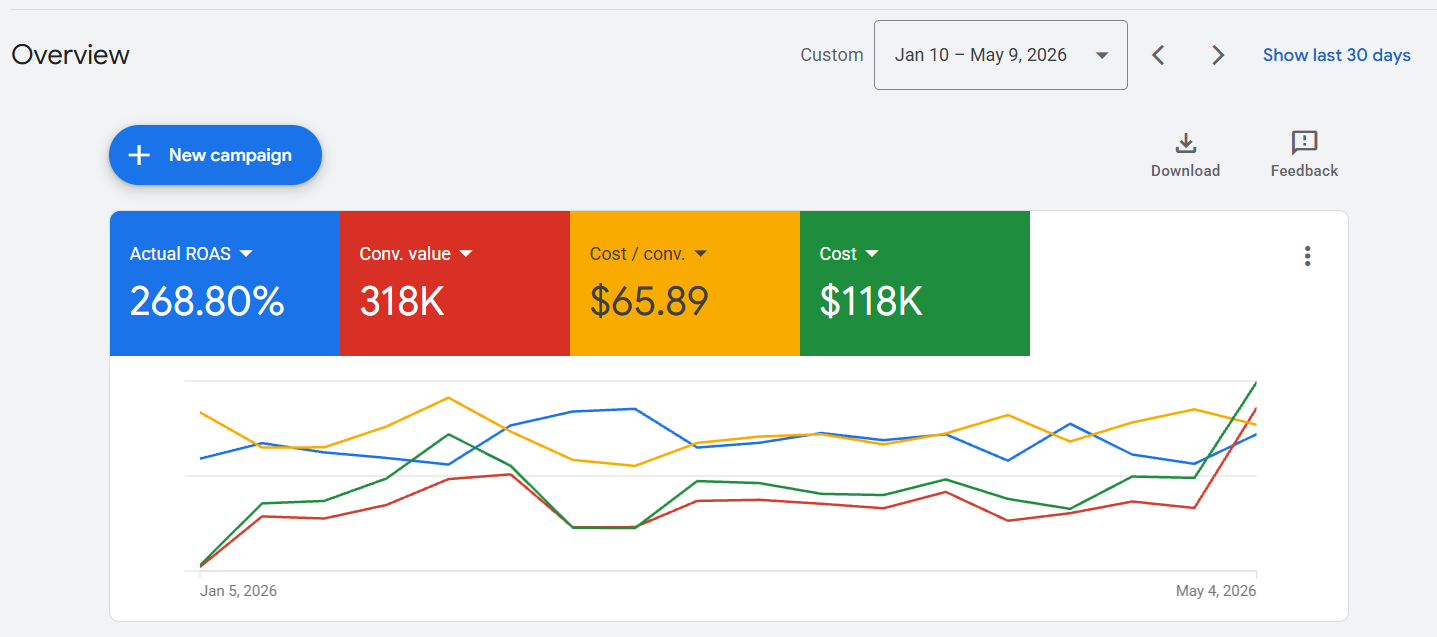
The period from January 10 to May 9, 2026 produced the following results across our florist Google Ads accounts:

Campaign Type Actual ROAS Conv. Value Ad Spend Cost / Conv.
High-Intent Local Search 1,066.50% $142,000 $13,400 $3.59
Occasion & Gift Search 669.27% $80,500 $12,000 $27.94
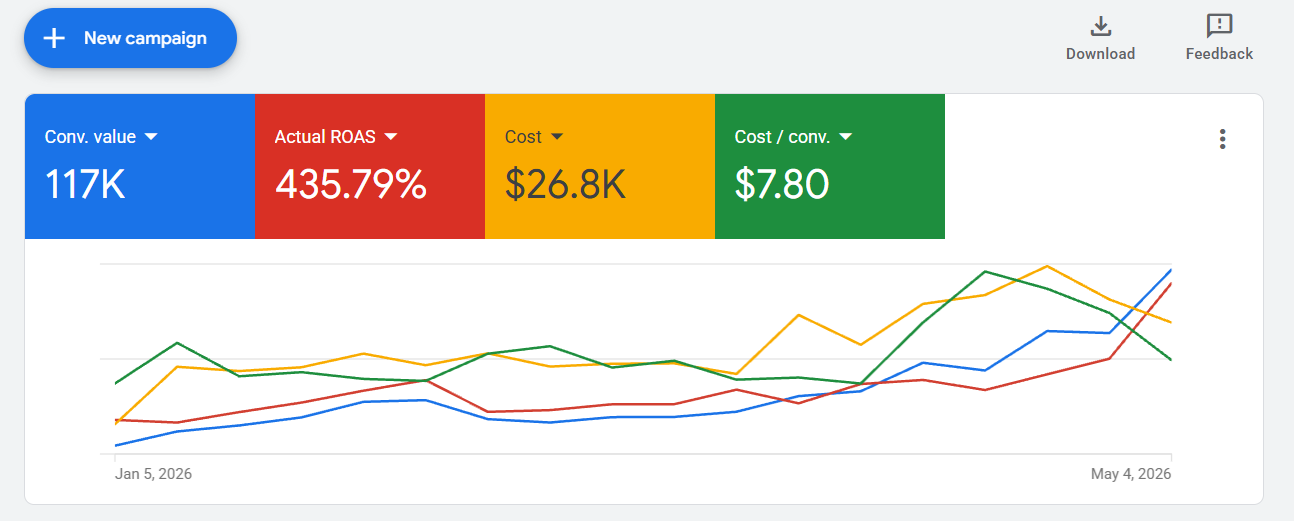
Brand + Remarketing 435.79% $117,000 $26,800 $7.80
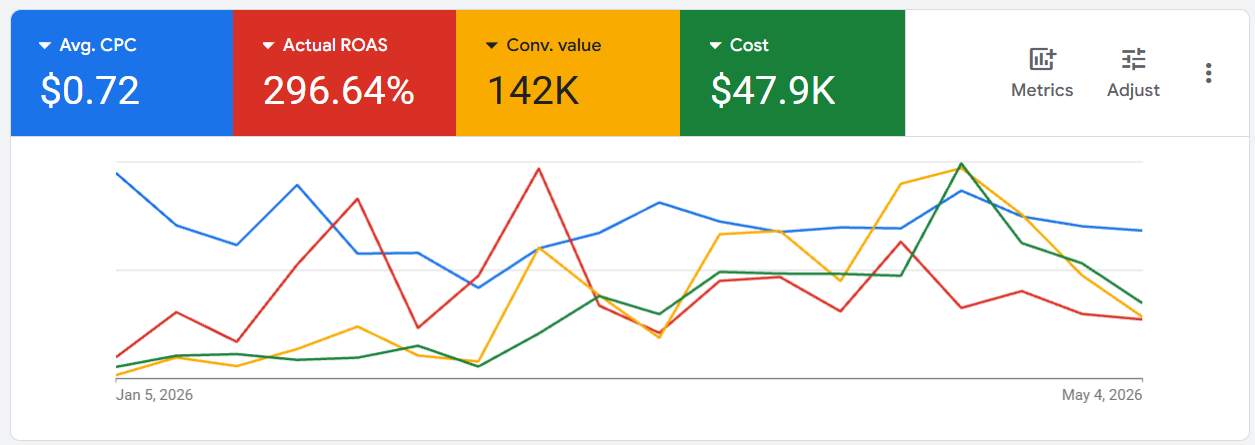
Overall Account (Blended) 268.80% $318,000 $118,000 $65.89

The blended account ROAS of 268.80% includes all campaign types — prospecting, remarketing, brand, and seasonal. Isolating our best-structured local search campaign reveals the 1,066% figure that's possible when every element is optimized.

Why Campaign Separation Is Everything

The single biggest mistake florists make in Google Ads is running one campaign for everything. When a high-performing keyword like "same-day roses delivery" sits in the same campaign as a low-converting keyword like "types of spring flowers," Google's algorithm dilutes your budget across both.

We separate campaigns into distinct buckets:

01
High-Intent Local Search
"Flower delivery [city]", "same-day florist near me", "buy flowers today [zip]" — the highest-converting keywords, isolated and given budget priority.
02
Occasion & Gift Keywords
"Mother's Day flowers", "anniversary bouquet", "birthday flower delivery" — strong seasonal intent, managed with adjusted bid schedules.
03
Brand Campaign
Protect your brand name from competitors and capture high-converting branded search at a fraction of the CPC of generic terms.
04
Remarketing
Re-engage visitors who browsed your shop but didn't purchase. These audiences convert at 2–4x the rate of cold traffic with much lower CPCs.

The 6-Step Google Ads Strategy for Florists

Here is the exact framework we apply to every florist Google Ads account we manage:

1

Revenue-linked conversion tracking

We track purchases with actual order values passed to Google Ads. This allows Target ROAS bidding to optimize for revenue, not just clicks. Most florists only track form submissions — that's like navigating without GPS.

2

Tightly themed ad groups with exact-match keywords

Each ad group targets a single keyword theme. "Same-day flowers [city]" gets its own ad group with an ad that says "Same-Day Flower Delivery in [City]" — maximum relevance, maximum Quality Score.

3

Aggressive negative keyword management

We block searches like "DIY bouquet", "fake flowers", "wholesale flowers", "free flower delivery" — terms that attract clicks but never convert. This alone can reduce wasted spend by 20–30%.

4

Geo-targeting by delivery radius

We target only ZIP codes within your delivery area — not your whole state or metro. A florist in Santa Monica doesn't benefit from clicks in Pasadena. Tight geo-targeting drops CPCs and lifts conversion rates.

5

Seasonal budget pacing

We ramp budgets 2–3 weeks before Mother's Day, Valentine's Day, and Christmas — capturing early shoppers when CPCs are still lower, then maintaining spend through the peak window.

6

Target ROAS bidding with guardrails

Once accounts have 30+ monthly conversions, we switch to Target ROAS bidding at a conservative target and scale up incrementally. This compounds gains week over week through the peak season.

Featured Snippet Answer: The best Google Ads strategy for florists combines high-intent local search campaigns, revenue-based conversion tracking, tight geo-targeting by delivery radius, and Target ROAS bidding. Separating campaign types (local search, occasion/gift, brand, remarketing) and managing negative keywords aggressively are the two factors that most consistently separate 200% ROAS accounts from 1,000%+ ROAS accounts.

What a 1,066% ROAS Means for Your Business

Put simply: for every $1,000 spent on Google Ads with this campaign structure, the florist received $10,665 in revenue. On a $13,400 spend during the Mother's Day season, that produced $142,000 in total revenue.

The industry average ROAS for retail Google Ads campaigns sits around 200–400%. Our florist campaigns consistently outperform that benchmark because we operate with the specificity that the floral industry demands — local delivery constraints, seasonal demand curves, high-AOV occasion keywords, and conversion tracking that speaks directly to revenue.

Google Ads for Florists — FAQs

Answers to the most common questions we get from florists about Google Ads.

How much should a florist spend on Google Ads?
Most florists see strong returns starting at $1,500–$3,000/month in ad spend. During peak seasons like Mother's Day and Valentine's Day, budgets of $5,000–$15,000/month are common. The key is not how much you spend, but how efficiently your campaigns are structured. Our top florist campaign spent $13,400 during the Mother's Day season and generated $142,000 in revenue — a 1,066% ROAS.
What is a good ROAS for florists on Google Ads?
A good ROAS for florists on Google Ads is generally 300–500% (3x–5x return on ad spend). A great ROAS is 600%+ (6x+). Our florist campaigns this Mother's Day achieved between 435% and 1,066% ROAS, with a blended account ROAS of 268.80% across all campaign types including brand, remarketing, and prospecting.
Does Google Ads work for florists?
Yes — Google Ads is one of the most effective marketing channels for florists because it captures high-intent searches like "same-day flower delivery near me" and "Mother's Day flowers [city]." People searching these terms are ready to buy. Our florist clients consistently achieve 4x–10x ROAS on well-structured Google Ads campaigns.
What Google Ads campaign types work best for florists?
The best Google Ads campaign types for florists are: (1) Search campaigns targeting high-intent keywords like "flower delivery [city]" and "same-day florist near me," (2) Shopping campaigns for product-level visibility, (3) Performance Max campaigns for broad reach during peak seasons, and (4) Remarketing campaigns to re-engage website visitors who didn't purchase. Separating these into distinct campaigns — each with its own budget and bidding strategy — is key to achieving high ROAS.
How do florists reduce cost-per-click on Google Ads?
Florists can reduce CPC on Google Ads by improving Quality Score through tightly themed ad groups, using exact-match and phrase-match keywords, writing highly relevant ad copy, and ensuring landing pages directly match the search intent. Negative keywords are also critical — filtering out non-buying searches like "free flowers" or "DIY bouquet tutorials" dramatically improves efficiency and reduces wasted spend.
When should florists increase their Google Ads budget?
Florists should increase Google Ads budgets 2–3 weeks before peak holidays: Mother's Day (early–mid May), Valentine's Day (early February), and Christmas/Hanukkah (mid–late December). These three holidays typically account for 40–60% of annual floral revenue. Ramping up spend before — not during — these windows captures early shoppers when CPCs are still lower.
Should florists use Google Shopping Ads?
Yes. Google Shopping Ads display your actual flowers, prices, and shop name directly in search results with an image — which dramatically increases click-through rates for high-intent searches. Shopping Ads work best when paired with a well-structured Google Merchant Center feed and product titles optimized for search terms like "red rose bouquet same-day delivery."

Ready to See These Results in Your Account?

We're accepting new florist clients. Get a free Google Ads account audit and see exactly where you're leaving revenue on the table.

Book Your Free Audit →
Previous
Previous

How to Run Meta Ads for Flower Shops

Next
Next

Florist Marketing Agency